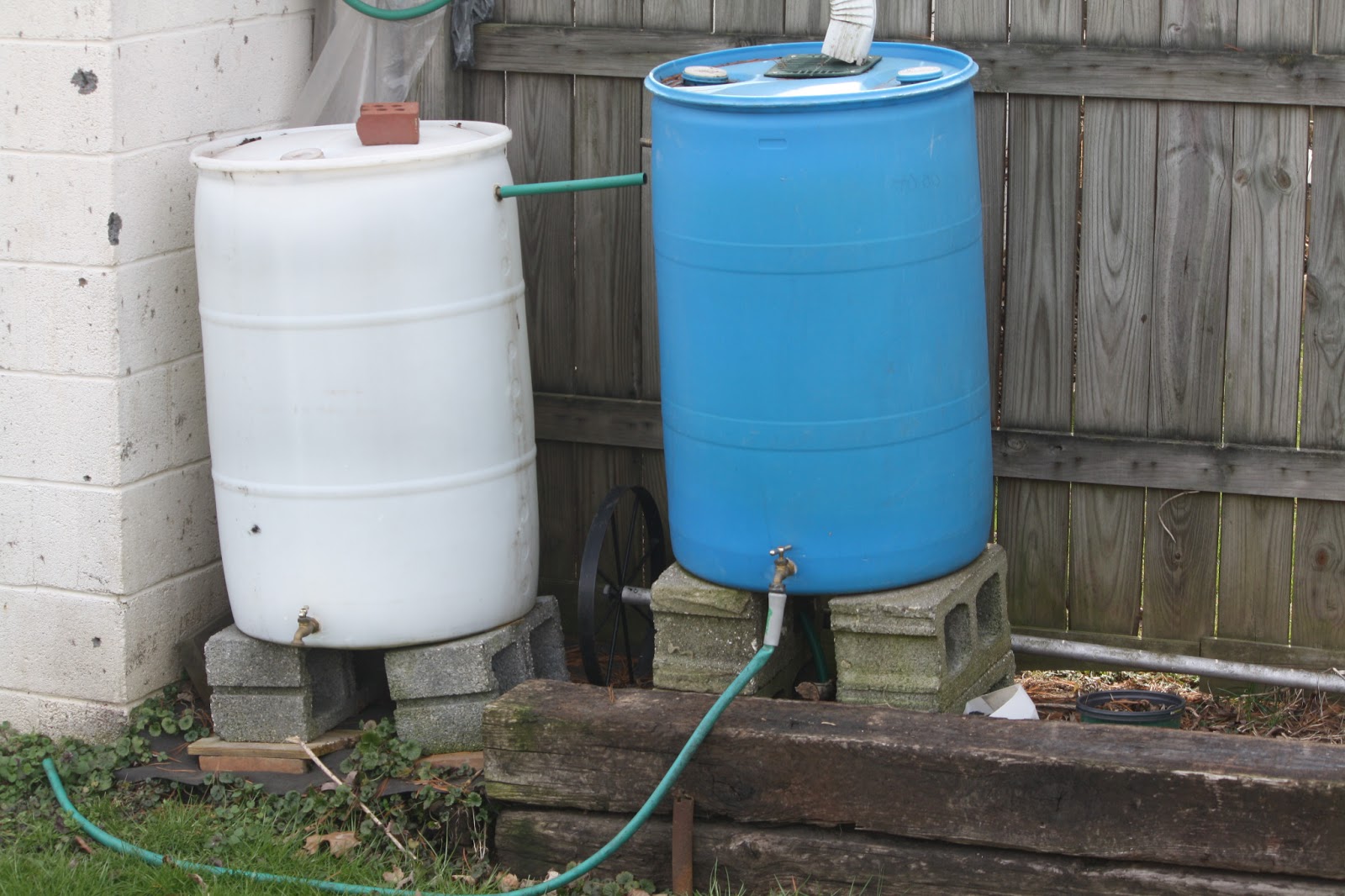
It doesn't matter if you collect rain water for your own consumption or to water your garden, you still need to do a yearly maintenance to them. Why? Its to keep them in tip top shape and it keep's the water in them safe for you and your plants.You wouldn't believe the stuff that gets inside of them, especially when they aren't in much use (in the off season)! So what are the thing's you should do to your rain barrels or other rain collection systems?
(Click her to learn how to make a Rain Barrel) Also You may like
Got Rain Barrel Questions?
Take a good look at them before you even drain them and remove them from the stand you have them on. As you can see by from my pictures, the winter freezing of the ground made mine a little unlevel and some of my connections come apart. So I will have to fix that as well!
 |
| See how the became unlevel |
Check All The Hardware:
You will want to totally drain your barrel before you get started. Then Check all your valves, connection, screens that you may have at the enter point and the overall condition of the barrel or container, replace anything that needs replaced. Look inside it, I am sure you will see lots of yucky stuff, maybe even algae
but that's okay we are gonna take care of all of this shortly and even have some preventative maintenance. At this point just spray out with you garden hose as much as you can.
Clean The Inside:
If you need to scrub the interior of the barrel a long handled brush
will work well. Using a mixture of light bleach
and water solution; scrub the interior of the barrel’s walls and bottom
with the brush. Then rinse your barrel again and let dry. This is something that you may not have to do if you have a constant flow of water going through your barrels.
But if you forgot to drain all the water out for the winter, Yuck!
Tip: Paint your rain barrels a dark color to prevent the sunlight from directly hitting your water and promoting algae growth.
Purifying The Water For Drinking and To Maintain:
You can add a little household bleach to your water to keep it maintained through out the year. A little won't hurt you plants either. I would put a little less in the water if you arn't gonna drink out of it and it will still keep the water cleaner!
According to the Red Cross,
“The
only agent used to purify water should be household liquid
bleach.
Add 16 drops of bleach per gallon of water if the water is cloudy (with an eye dropper), stir
and let stand for 30 minutes. (If it’s clear, only add 8
drops.)
If the water does not have a slight bleach odor [after 30 minutes],
repeat
the dosage and let stand another 15 minutes.” Use household
bleach
(5.25% sodium hypochlorite as its only active ingredient) and yes this is for drinking!
How much bleach to use for purifying water for drinking (according to the Red
Cross):
| amount of water |
clear water |
cloudy water |
| 1 quart |
2 drops |
4 drops |
| 1 gallon |
8 drops |
16 drops |
| 5 gallons |
1/2 teaspoon |
1 teaspoon |
| 55 gallons |
5 1/2 teaspoons |
11 teaspoons |
 |
| After I built a foundation out of railroad ties. |
Revelation 21:1"And he showed me a pure river of water of life, clear as crystal, proceeding from the throne of God and of the Lamb."
Linked With:
Blog It UP!, Down Home Blog Hop,
Home and Garden Thursday,
Thursdays Favorite Things,
Simple Lives Thursday,
The HomeAcre Hop,
Bloglovin,
Friday Fertilizer Flaunts,
Freedom Fridays,
Linky Love Blog,
Simply Natural Living,
Farm Girl Friday,
Homestead Saturday,
Pinteresting Party,
Sunny Simple Sunday,
MMM,
Clever Chicks Hop,
Natural Living Monday,
Harvest Monday,
Teach Me Tuesday,
Backyard Farm Connection,
Tuesday Garden Party,
 Storing
survival garden seeds... along with growing an emergency garden is very important for emergency preparedness or a food shortage crisis and also will save you lots of money in
the long run! As the value of money decreases, the value of food and vegetable
seeds will increase. Vegetable seeds are a major food-source, and should be
considered one of the most valuable
commodities of all for emergency and
survival preparedness, as well!