|
|||
| Brussels Sprouts – Brussels sprouts are ideal for fall gardens because they really taste best when allowed to mature in cool weather. In my mid-South garden, summer comes too quickly to grow them in the spring garden. Set the plants out in mid-summer. It will take about 3 months before the sprouts appear. They are ready for harvest when they are firm and green. 90 days to maturity. | |||
| Cabbage – Plant seedlings 6 to 8 weeks before the first frost. If the heat of summer is still intense when it's time to plant in your area, give the young plants protection from sun. Cabbages are heavy feeders that require fertile soil rich in organic matter and consistent moisture. 70 days to maturity. | |||
| Cauliflower - Plant seedlings 6 to 8 weeks before the first frost. Cauliflower can be tricky to grow. Rich soil and consistent watering are the keys. Fluctuations in temperature, moisture and nutrients can cause the plant to "button" or produce small, undersized heads. Blanch the heads by tying the outer leaves together over the heads when they are about 2 to 3 inches across. This keeps them from turning green and becoming bitter. 60 days to maturity. | |||
| Kohlrabi - Kohlrabi is a member of cabbage family, but it looks and tastes similar to a turnip. The bulbous edible portion grows just above the soil line. Shade young plants from summer sun. 40 to 60 days to maturity depending on variety. | |||
| Lettuce – Sow seeds in late summer. Provide the seedlings with consistent moisture and shade from the afternoon sun. 45 to 60 days to harvest depending on type and variety. | |||
| Mustard Greens – Sow seeds 6 weeks before the first frost. Seeds will germinate in soil that is 45 to 85 degrees F. Keep the soil consistently moist to encourage rapid growth and tender greens. 45 days to maturity. | |||
| Radish – Sow seeds for radishes 4 weeks before the first frost. Winter varieties such as China Rose, mature slower, grow larger and store longer. They should be sown about 6 weeks before the first frost. Sow the seeds evenly so you don't have to thin them. No feeding necessary, but soil should be fertile and well drained. They are quick to mature so check them regularly. They are ready to harvest as soon as they are of edible size. 25 to 50 days to maturity depending on variety. | |||
| Rutabaga – Sow seeds 12 weeks before the first frost. In regions where summer is long and hot, wait to sow seeds until night time temperatures are consistently around 50 to 60 degrees F. Rutabagas are a cross between cabbage and turnip. Although they are suitable for early spring gardens, they seem to have the best flavor when grown in fall. Keep the soil consistently moist to prevent roots from forking. 90 days to maturity. | |||
Spinach – Sow seeds 5 weeks before first
frost date. The short days and cool, moist weather of fall is even
better for spinach than spring. An established spinach crop will last
well into winter and can survive temperatures down into the 20s.
Spinach prefers very fertile soil to encourage rapid growth and tender
leaves. 45 days to maturity.
Linked with: Blog Carnival Country Garden Showcase Barn Hop 80 |
Sunday, September 23, 2012
10 Vegetables to Grow in the Fall
Some people have asked, "What can I grow in the fall to winter months in my garden?" Well here are 10 very easy to grow veggies that you can enjoy in the cool season and sometimes into the first snow! As you plant and grow please let me know how your crops are doing! I trust everyone has had a great growing season so fare?


Friday, September 21, 2012
"The Journey" by Robert Brunell
My wife found this story years ago, and before I published it I wanted to explain a couple of things. When I first read the story, it really made me madder than a wet hen. Because I saw a lot of myself, at that, time in this story. I saw a lot of the people that I was around the same way and well I got mad, okay, lol! So I post this with caution in hope that you will read the whole thing and just take it all as a teaching of where we can slip as the body of Christ if we are not cautious and do as God tells us in 1 John 4:1-6 and "test everything". It is a lengthy read and must of you probably wont read it but for you that do, I promise you will be blessed! Or maybe mad like I was but God taught me a lot from this! This isn't an "Escape from our Savior Jesus Christ". God Bless you all!
Numbers 22:24 "Then the Angel of the LORD stood in a narrow path between the vineyards, with a wall on this side and a wall on that side."
Numbers 22:24 "Then the Angel of the LORD stood in a narrow path between the vineyards, with a wall on this side and a wall on that side."
"Escape from Christendom"
"The Journey" by Robert Burnell, 1980
 In my dream I see the lone figure of a man following a road.
As
the sun sets beneath the hills, a city comes into view. Nearing it, the
traveler sees what appears to be a large group of churches. Spires and
crosses pierce the skyline. His pace quickens. Is this his destination?
He passes an imposing structure, a neon sign flashing “Cathedral of the
Future.” Farther on a floodlit stadium supports a billboard boasting
that fifty thousand people crowd into evangelistic meetings there three
nights a week. Beyond this, modest “New Testament” chapels and Hebrew
Christian synagogues cluster together on the street front.
“Is this the City of God?” I hear the traveler ask a woman at the information booth in the central square.
“No this is Christian City, “she replies.
“But I thought this road led to the City of God!” He exclaims with great disappointment.
“That’s what we all thought when we arrived,” she answers, her tone sympathetic.
“This road continues up the mountain, doesn’t it?” He asks.
“I wouldn’t know, really,” she answers blankly.
I
watched the man turn away from her and trudge on up the mountain in the
gathering darkness. Reaching the top, he starts out into the blackness;
it looks as though there is nothing, absolutely nothing, beyond. With a
shudder he retraces his steps into Christian City an takes a room at a
hotel.
Strangely unrefreshed, at dawn he arises and follows the
road up the mountain again; in the brightening light of the sun he
discovers that what seemed like a void the night before is actually a
desert–dry, hot, rolling sand as far as the eye can see. The road
narrows to a path which rises over a dune and disappears. “Can this
trail lead to the City of God?” He wonders aloud. It appears to be quite
deserted and rarely traveled.
Indecision slowing his steps, he
again returns to Christian City and has lunch in a Christian restaurant.
Over the music of a gospel record, I hear him ask a man at the next
table, “That path up the mountain, where the desert begins, does it lead
to the City of God?”
“Don’t be a fool!” his neighbor replies
quickly. “Everyone who has ever taken that path has been lost… Swallowed
up by the desert! If you want God, there are plenty of good churches in
this town. You should pick one and settle down.”
Saturday, September 15, 2012
Saving Tomato Seeds, for next year?
Well its that time of the year when we will start canning, cleaning the garden up, planting fall crops and one of my favorite thing to do is, "Seed Saving", something Grammie taught us how to do! One of the plants I want to carry over this year is my San Marzanos Tomatoes! Why you may ask, because you can get that wonderful tomato that really love, year after year and it will start to adapt to your environment (read more in link below on "Heirloom".) So how do we do this task that for generations people have done?
Well prabaly the most important part is, choosing the right tomatoes for "Seed Saving".
There are a few things to keep in mind when deciding which tomatoes to use for seed saving:
* They should be from "Heirloom" varieties. "Hybrid" tomatoes won't come true from seed, so if you save seed from a hybrid and plant it, you will get tomato plants, but there's no way of telling whether the tomatoes will be any good or if you will even get the same tomato?
*They should be fully ripe, but not over-ripe.
* They should be the best-looking tomatoes on your plant. When you save seeds, you want to save from those fruits that have the very best quality.
So here is a step by step on this really simple process.
1. Choose a ripe and the most perfect tomato you have on the healthiest plant you had all season.Choose it off the plant that produced the biggest yield and with the least amount of problems.Remember, you will be getting the same plant as the fruit comes from next year.
2. Cut it open, right through the middle!
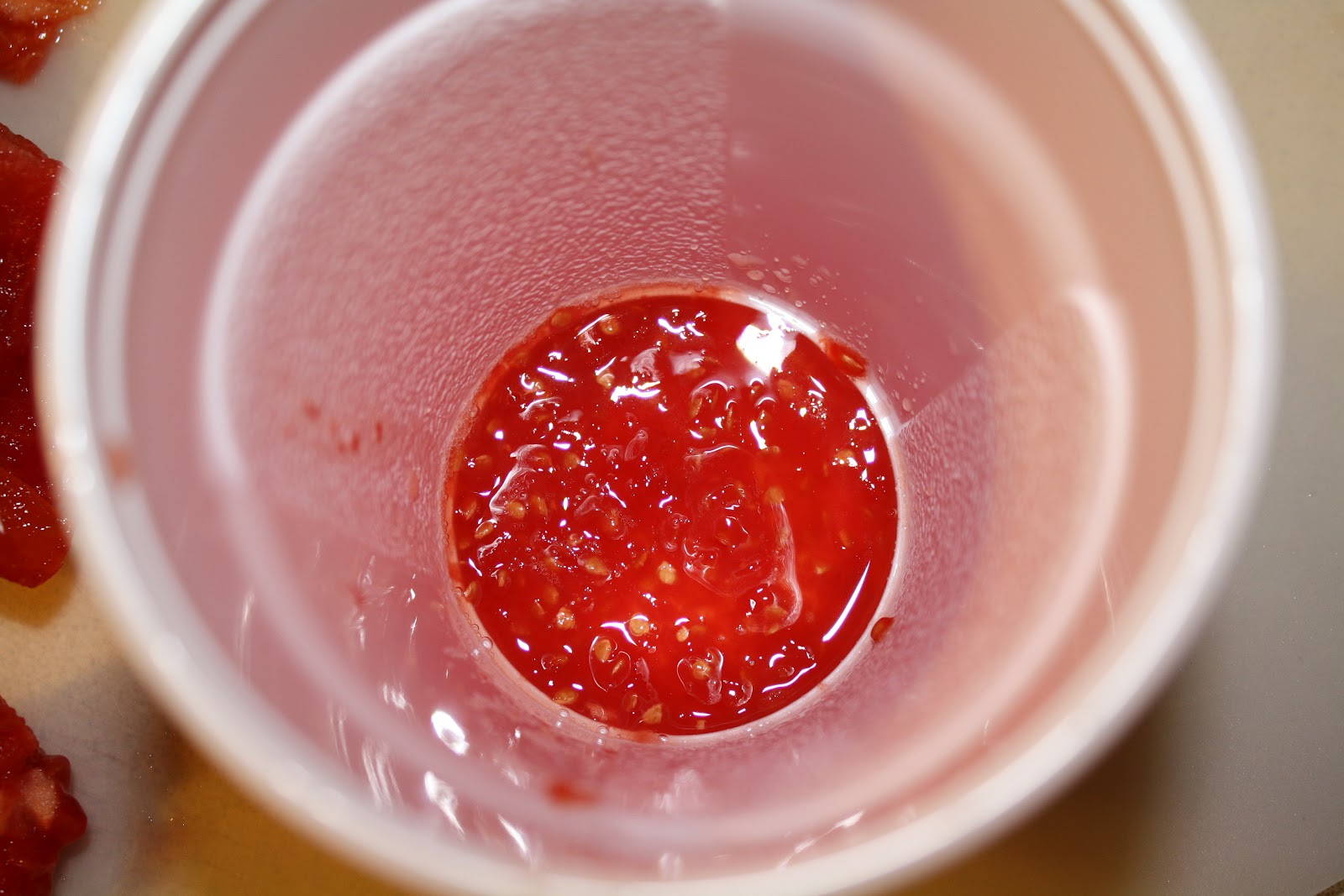
3. Squeeze the seeds, "gunky" stuff, out into a small cup or jar.
4. Cover the seed gunk with two to three inches of water.
5. Label your cup so you know which variety of tomato you saved seeds from.
6. After about three days, white mold will start to form on the surface of the water. This means that the gel or "gunky" stuff, lol, on the seeds has dissolved.
7. Once you see the white mold, pour off the mold, the water, and any seeds that are floating (Remember the post "Sink or Swim" floating seeds are bad - they probably won't germinate next year) You want all of those seeds sitting at the bottom of the cup, they will have a better chance to grow strong, healthy plants next year.
8. After you've poured the mold and bad seeds off, drain your seeds in a fine mesh strainer and rinse under running water. It's not a bad idea to stir the seeds around with your fingers to help remove any extra gel that may be clinging to them.
9. Dump your rinsed seeds onto a paper plate that has been labeled with the variety name. The paper plate will wick away the water and help keep seeds from getting moldy, we don't want that!
10. Make sure your seeds are in a single layer on the plate, and set it aside a few days so the seeds can completely dry.
11. Once they're dry, put them in a labeled envelope, baggie, or other container and store in a cool, dry spot.
*A link to help with more in depth question's you may have: Master Gardener's and Organic Gardening (for more related photo's)!
“And we have known and believed the love that God has for us. God is love, and he who abides in love abides in God, and God in him.” 1 John 4:16
Well prabaly the most important part is, choosing the right tomatoes for "Seed Saving".
There are a few things to keep in mind when deciding which tomatoes to use for seed saving:
* They should be from "Heirloom" varieties. "Hybrid" tomatoes won't come true from seed, so if you save seed from a hybrid and plant it, you will get tomato plants, but there's no way of telling whether the tomatoes will be any good or if you will even get the same tomato?
*They should be fully ripe, but not over-ripe.
* They should be the best-looking tomatoes on your plant. When you save seeds, you want to save from those fruits that have the very best quality.
 |
| Photo by "The Redeemed Gardener" |
Good tomatoes = good seeds = really good tomatoes next year!
So here is a step by step on this really simple process.
1. Choose a ripe and the most perfect tomato you have on the healthiest plant you had all season.Choose it off the plant that produced the biggest yield and with the least amount of problems.Remember, you will be getting the same plant as the fruit comes from next year.
2. Cut it open, right through the middle!
3. Squeeze the seeds, "gunky" stuff, out into a small cup or jar.
4. Cover the seed gunk with two to three inches of water.
5. Label your cup so you know which variety of tomato you saved seeds from.
6. After about three days, white mold will start to form on the surface of the water. This means that the gel or "gunky" stuff, lol, on the seeds has dissolved.
 |
| Photo by "The Redeemed Gardener" |
7. Once you see the white mold, pour off the mold, the water, and any seeds that are floating (Remember the post "Sink or Swim" floating seeds are bad - they probably won't germinate next year) You want all of those seeds sitting at the bottom of the cup, they will have a better chance to grow strong, healthy plants next year.
8. After you've poured the mold and bad seeds off, drain your seeds in a fine mesh strainer and rinse under running water. It's not a bad idea to stir the seeds around with your fingers to help remove any extra gel that may be clinging to them.
9. Dump your rinsed seeds onto a paper plate that has been labeled with the variety name. The paper plate will wick away the water and help keep seeds from getting moldy, we don't want that!
10. Make sure your seeds are in a single layer on the plate, and set it aside a few days so the seeds can completely dry.
11. Once they're dry, put them in a labeled envelope, baggie, or other container and store in a cool, dry spot.
*A link to help with more in depth question's you may have: Master Gardener's and Organic Gardening (for more related photo's)!
“And we have known and believed the love that God has for us. God is love, and he who abides in love abides in God, and God in him.” 1 John 4:16
Friday, September 7, 2012
"San Marzano's" Grown in West Virginia!
I tried a new variety of tomato this year. Well, new for me, lol! It is the "San Marzano" tomato from Italy. San Marzano Tomatoes are a plum tomato variety. They are a household name when it comes to making tomato sauce in Italy. They’re also particularly suitable for preparing peeled tomatoes,
canned tomatoes, or dried tomatoes. In fact, skin comes
off so easily from San Marzanos that they’re sometimes called, “The King
of Peeled.”
 They're named for their origin, certified San Marzano tomatoes
are grown in Campania, a region of southern Italy just above the toe of
the boot, called Sarnese Agro-Nocerino (Valle del Sarno or valley of
the Sarno). Those grown and processed in the valley of Sarno in
compliance with Italian law are stamped with “D.O.P.” emblem on the can
label, which means "Denominazione di Origine Protetta." Don't ask me, thats a little bit more than I really needed to know. I just though maybe some of you smart fellers out there would want to know, lol! The taste of “genuine” San Marzanos is said to be, because they are grown in volcanic, rich
soil and the Mediterranean climate.
They're named for their origin, certified San Marzano tomatoes
are grown in Campania, a region of southern Italy just above the toe of
the boot, called Sarnese Agro-Nocerino (Valle del Sarno or valley of
the Sarno). Those grown and processed in the valley of Sarno in
compliance with Italian law are stamped with “D.O.P.” emblem on the can
label, which means "Denominazione di Origine Protetta." Don't ask me, thats a little bit more than I really needed to know. I just though maybe some of you smart fellers out there would want to know, lol! The taste of “genuine” San Marzanos is said to be, because they are grown in volcanic, rich
soil and the Mediterranean climate.
Mostly here in the U.S. we have grown "Roma's"for the same Reasons and uses. Grammie always had a row or two of Roma's in her garden to can. In looking up some differant facts on "San Marano's". I found a great web site that tells you everything from facts and History to Recipes for your tasting www.sanmarzanotomatoes.org ! And of coarse I recieved my seeds from Botanical Interests.
I personally love them. I am gonna try to hold seeds back and get them used to the good ol' West "By Golly" Virginia soil and environment. While we don't have the volcanic soil and Mediterranean climate, we do have all kinds of coal rich soil and a power plant down the river that could make the water warmer....Okay, I guess I am stretching it a little but maybe after a few years they will adapt better, lol! So if you are looking to try a different heirloom next year try San Marzano's, good luck!
Daniel 4:12 Its leaves were lovely, Its fruit abundant, And in it was food for all.

Mostly here in the U.S. we have grown "Roma's"for the same Reasons and uses. Grammie always had a row or two of Roma's in her garden to can. In looking up some differant facts on "San Marano's". I found a great web site that tells you everything from facts and History to Recipes for your tasting www.sanmarzanotomatoes.org ! And of coarse I recieved my seeds from Botanical Interests.
I personally love them. I am gonna try to hold seeds back and get them used to the good ol' West "By Golly" Virginia soil and environment. While we don't have the volcanic soil and Mediterranean climate, we do have all kinds of coal rich soil and a power plant down the river that could make the water warmer....Okay, I guess I am stretching it a little but maybe after a few years they will adapt better, lol! So if you are looking to try a different heirloom next year try San Marzano's, good luck!
Daniel 4:12 Its leaves were lovely, Its fruit abundant, And in it was food for all.
Thursday, August 30, 2012
"Blue Ribbon at the West Virginia State Fair"
I am so proud of my wife and her accomplishments! This year she entered one of her cross stitches into the West Virginia State Fair, thinking all she would do would be displaying her work for all to see. But that wasn't the case, SHE WON a first place blue ribbon! I will link her blog here so you can read in detail and see her progress as she stitched this beautiful cross stitch. "Maple Cottage Stitcher" is the name of her blog for those of you that don't know! She worked almost a whole year on this.
Here is a link the the song that she partially stitched on her sampler Hymn and History of "It is Well With My Soul". It is a wonderful but heartbreaking story if you have never heard the story on when, where and why Horatio Gates Spafford wrote this wonderful song!

So again Congratulations and I can't wait to see the next one! Again I am so proud of her and her work!
Psalm 107:29"He calms the storm, So that its waves are still."
Linked with:
Weekend Whatever
Fertilizer Friday
Home and Garden Thursday
Treasure Hunt Thursday
Rural Thursday
Thursdays Favorite Things
This and That Thursday
Home Makers Hop 36
Frugal Tuesday Tip
Tuesday Garden Party
Teach Me Tuesday
Barn Hop 77
Make A Move Monday
Blog Carnival 23
Monday, August 27, 2012
U.S. Drought 2012 and a story of my Grammie
As everybody in the U.S. knows we have had a very dry summer! It reminds me of one hot dry summer that I stayed with my Grammie. We had three large gardens going as always, since we preserved everything. I was about 13 and when I say hot, I mean hot! I would drive the tractor, with her on the back from garden to garden as we picked and watered. The road to the potatoes garden was very bumpy. On one of the hottest days of this summer, as always I drove her up the road but this time was a memorable event. As I drove she would say, "speed up its hot", then "slow down, you are jarring me to death", then "come on Clint we have to hurry", then "Please slow down I am about to bounce off". I couldn't please her, lol! So I stopped and asked her how she wanted me to drive, lol! To this day we laugh and talk of that day!
Well below is an article on the weather her this year. When you get to the bottom the is a link to a map that monitors the damaged areas of this drought. West Virginia doesn't look that bad but to us it feels awful. I can't even imagine what the rest of you are going through! It looks like many areas need lots of prayer! So water water water those plants! Make a Few Rain Barrels to collect water.
"STATE REMAINS ABNORMALLY DRY, DESPITE RECENT RAIN"
Article from http://www.wvagriculture.org/index.html
Article from http://www.wvagriculture.org/index.html
Most of West Virginia remained “abnormally dry,”
according to the U.S. Drought Monitor map dated July 17, 2012. However,
recent rains resulted in a small portion of southwest West Virginia
being removed from drought status, an improvement over previous
conditions that showed three-quarters of the state’s topsoil moisture
ranked as “poor.”
Despite marginal farm conditions, West Virginia has not had it nearly
as bad as the majority of the country, which is suffering from an
unprecedented heat wave and an historic drought.
Nationally, nearly 90 percent of the nation’s corn and soybean crops
are located in drought-stricken areas. The worsening drought conditions
will likely drive up food prices in the near term, and meat prices by
next year because corn and soybeans are predominant ingredients in
animal feed.
“I have requested farmers to keep detailed records of drought-related
losses in the hope that Congress restores emergency funding to the Farm
Bill that’s currently under consideration,” said Commissioner of
Agriculture Gus R. Douglass.
He called on Congress to move the bill to the White House and to
consider the plight of the farmers who had high hopes for a record corn
crop earlier this year.
“Farming is the most important industry in this country,” said
Commissioner Douglass. “First, it provides the food we all rely upon
each day. Second, it is among our most-important exports, regardless of
the condition of the world economy at any given time. And third, it
represents the finest of American ideals: ingenuity, hard work and
service to others. As a nation, we must do what it takes to get these
family businesses through this potentially ruinous natural disaster.”
The national drought map can be found at www.droughtmonitor.unl.edu.
The U.S. Department of Agriculture National Agricultural Statistics
Service (USDA-NASS) has detailed weekly reports on crop and weather
conditions around the country. Visit http://www.nass.usda.gov/Publications/State_Crop_Progress_and_Condition/index.asp for more information.
The West Virginia Department of Agriculture protects
plant, animal and human health through a variety of scientific,
regulatory and consumer protection programs, as mandated by state law.
The Commissioner of Agriculture is one of six statewide elected
officials in West Virginia. For more information, visit www.wvagriculture.org.
Sunday, August 26, 2012
How will Jesus come the second time?
How will Jesus one day return to earth when He comes back to the Mt. of
Olives at His second coming? Lets turn to scripture and see. Acts 1:
9-11 answers this for us: "Now when He had spoken these things, while
they watched, He was taken up, and a cloud received Him out of their sight.
10 And while they looked steadfastly toward heaven as He went up,
behold, two men stood by them in white apparel, 11 who also said, “Men
of Galilee, why do you stand gazing up into heaven? This same Jesus, who was taken up from you into heaven, will so come in like manner as you saw Him go into heaven.”
It appears that when Jesus returns for His children, He will return on
the clouds. This is for those that are saved (in Christ Jesus).
There is another return of Christ, this time spoken of in Revelation 19:11-14. This time the Heavens will open up and Christ is seen setting on a White horse. This is event is different then the rapture, this time Christ is coming to set up His kingdom, that He has promised. There will be an army following Him made up of His church, OT believers and even angles. On this return Christ is bringing "judgment and war", the Holy wrath of God will be poured out on all of sinful mankind that did not except the salvation He offered through His son Jesus. He will destroy all sin and corruption that is left on the earth, so His perfect and eternal Kingdom can be set up.
A song that I have listen to and sang in the past keeps coming back to me over the past few months. A song that has lots of truth in it, a "Christian" song. But God's word tells us that a little leave will spoil the whole batch (Gal. 5:9). The song is call "Make way for the King", by Lenny Leblanc, the song towards the end sings like this. "Make Way for the King, Cause He's Comin' on a white horse to carry me home." An example of why we need to do as James said and test everything or like the Bereans in Acts 17:11. Jesus isn't coming on a White Horse for His children, His redeemed. He is coming on a white horse because God patience will be gone with all the rebellious, sinful, corruption that mankind has become! Christ is coming on the white horse of Judgment and His followers will be right behind Him.
There is another return of Christ, this time spoken of in Revelation 19:11-14. This time the Heavens will open up and Christ is seen setting on a White horse. This is event is different then the rapture, this time Christ is coming to set up His kingdom, that He has promised. There will be an army following Him made up of His church, OT believers and even angles. On this return Christ is bringing "judgment and war", the Holy wrath of God will be poured out on all of sinful mankind that did not except the salvation He offered through His son Jesus. He will destroy all sin and corruption that is left on the earth, so His perfect and eternal Kingdom can be set up.
A song that I have listen to and sang in the past keeps coming back to me over the past few months. A song that has lots of truth in it, a "Christian" song. But God's word tells us that a little leave will spoil the whole batch (Gal. 5:9). The song is call "Make way for the King", by Lenny Leblanc, the song towards the end sings like this. "Make Way for the King, Cause He's Comin' on a white horse to carry me home." An example of why we need to do as James said and test everything or like the Bereans in Acts 17:11. Jesus isn't coming on a White Horse for His children, His redeemed. He is coming on a white horse because God patience will be gone with all the rebellious, sinful, corruption that mankind has become! Christ is coming on the white horse of Judgment and His followers will be right behind Him.
"Jesus will
come bathed in radiant splendor, enveloped within an atmosphere of
indescribable brilliance, surrounded by the ear-piercing praise of angels and
saints. Scintillating light shining from His eyes. Irresistible power pouring from His hands. None will deny
His beauty or escape its transforming energy." ~ Sam Storms
Linked With:
Teach Me Tuesday
Here it on Sunday, Use it on Monday
His Grip
Linked With:
Teach Me Tuesday
Here it on Sunday, Use it on Monday
His Grip
Subscribe to:
Posts (Atom)